By the Heart Medical Team · Contributions by Sabrina Elliott, RCIS, CCT
Sudden cardiac arrest (SCA) is one of the few medical emergencies where the outcome depends almost entirely on what happens in the first five minutes. The global survival rate from SCA is less than 1 percent. In the United States, where automated external defibrillators (AEDs) are more widely deployed, the survival rate climbs to around 5 percent — and for victims whose collapse is witnessed and who receive CPR plus an AED shock within three to five minutes, more than half can survive.¹
The difference between 1 percent and 50 percent isn't medicine. It's geography — whether an AED is close enough to reach the patient in time.
That math is the case for AEDs in every public facility, workplace, school, and gathering space. Florida just made that case at the policy level with House Bill 1607, which requires every public and charter school in the state to have at least one AED on grounds by July 1, 2027 — and other states are watching. But the case for AEDs doesn't wait for legislation. Office buildings, gyms, churches, hotels, manufacturing facilities, retail spaces, and government offices serve people who can have cardiac arrests regardless of what the law requires.
Below is a practical guide on what AEDs do, who should have one, what to look for when choosing a device, and how to keep it ready when the moment comes.
Quick answer
Which AED is best for facilities?
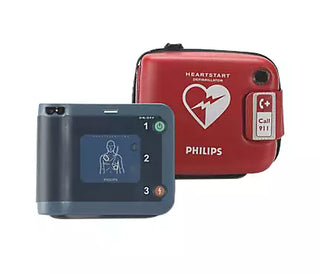
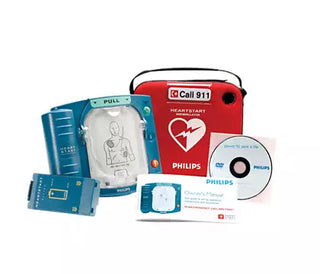
For schools, offices, manufacturing sites, churches, gyms, hotels, and government buildings, the Heartstream FRx (formerly the Philips HeartStart FRx) is the AED we recommend most often. It supports both adults and children, runs daily self-tests, and is designed to be operated confidently by people with no medical training.
Best for: Schools · Offices · Manufacturing Facilities · Churches · Gyms · Hotels · Government Buildings

What an AED actually does
An automated external defibrillator (AED) is a portable, battery-powered medical device that analyzes a patient's heart rhythm and, when a treatable arrhythmia is detected, delivers a calibrated electrical shock to restore a normal rhythm. Below is what that actually looks like in use, and what makes modern units usable by non-clinicians.
An automated external defibrillator is a portable, battery-powered device that delivers a controlled electrical shock to a heart in a treatable arrhythmia — most commonly ventricular fibrillation. The device's role is to interrupt the abnormal rhythm and give the heart a chance to restart its normal electrical pattern.
Modern AEDs are explicitly designed for lay rescuers — not just medical professionals. Once the device is opened and turned on, it speaks aloud, showing pictograms and giving step-by-step instructions: place the pads on the patient's chest, stand back, push the shock button when prompted. The AED itself analyzes the heart rhythm and only authorizes a shock if a treatable arrhythmia is detected. A bystander cannot accidentally shock someone who doesn't need it.
This design is intentional. Sudden cardiac arrest doesn't announce itself or wait for paramedics. The lay-rescuer-friendly AED is the equipment innovation that pushes cardiac arrest survival from grim to genuinely hopeful in venues where trained medical staff aren't on hand.
Who should have an AED?
For decades, AEDs lived primarily in hospitals, ambulances, and clinics. That's now the minority deployment. The faster-growing AED market is in non-medical facilities where the public gathers:
- Workplaces with 50+ employees on site — especially those with physical labor, older workforces, or shift work
- Schools of all sizes (K-12 and higher education) — Florida law now mandates this; other states are likely to follow
- Gyms, fitness centers, and sports venues — places where physical exertion can trigger cardiac events in otherwise healthy people
- Houses of worship — typically older demographics, often without on-site medical staff
- Hotels, conference centers, and event venues — high foot traffic, mix of ages and health profiles
- Government offices, libraries, courthouses, and community centers — public-serving facilities with civic responsibility
- Manufacturing and warehouse facilities — physical work, sometimes remote from EMS response
- Restaurants and retail — high foot traffic, mostly without trained medical responders
- Outpatient cardiology practices, urgent care clinics, primary care offices — backup support equipment

If your facility serves the public or employs staff, the question isn't whether an AED makes sense. It's how many and where.
Scoping AEDs for your facility?
We can walk through unit selection, placement, signage, and a maintenance plan in one conversation.
Talk to our team →Florida school AED requirements (HB 1607)
Beginning July 1, 2027, every public and charter school in Florida must have at least one AED on campus, per House Bill 1607 (the Second Chance Act). The law is the first of its kind in the United States and is being closely watched by other state legislatures.
For school administrators preparing for the deadline, the law's intent goes beyond simply mounting a device on a wall. A defensible AED program includes:
- Placement. Units mounted where they're reachable within three minutes of any point on campus — typically near gymnasiums, athletic fields, main offices, and high-traffic hallways.
- Staff CPR + AED training. Designated responders trained at least annually. No formal certification is required to use an AED, but trained staff respond faster and more confidently.
- Battery and pad replacement scheduling. Pads expire every 2 years; batteries last up to 4 years. Without a tracked replacement calendar, devices go silently non-functional.
- Pediatric readiness. Schools serve students of all ages. AEDs with adult/pediatric capability (like the Heartstream FRx with its optional Infant/Child Key) cover the full population without requiring two pad sets.
- Emergency response planning. Integration with the school's existing AED location protocols, security systems, and first-responder coordination.
For the deeper background on the law, the medical case behind it, and what athletic and school-administration leaders need to know, see our companion piece: Florida's Second Chance Act and EKG screening law →
What to look for in an AED
The AED market includes several manufacturers. When evaluating a unit for a non-medical facility, the features that matter most are practical, not specifications-sheet items:
Lay-rescuer friendliness. Voice prompts in plain English (and Spanish where appropriate), clear pictograms, simple button layout. Devices that require formal training to operate confidently are the wrong choice for facilities staffed by non-clinicians.
Adult and pediatric capability. Most facilities serve a mix of ages. The best units handle both adults and children either through smart pads or a simple key switch — not by requiring two separate pad sets to stock and maintain.
Durability. AEDs live mounted on walls in hallways, gymnasiums, and lobbies for years before they're needed. Look for units rated to withstand drops, dust, moisture, and physical impact. The unit needs to work when picked up after three years on a wall.
Long battery life and self-testing. A high-quality AED tests itself daily, weekly, and monthly — checking battery readiness, pad continuity, and circuit calibration. Look for four-year battery intervals with a clear status indicator visible without opening the device.
Pre-connected pads. When seconds matter, the pads should already be attached to the device. Connectorless designs add steps that don't help.
Maintenance plan, not just a device. Pads expire. Batteries expire. Whatever AED you choose, the replacement parts and the maintenance cycle are part of the buying decision — not an afterthought. A unit you forget about for five years and find dead in an emergency is worse than no AED at all.
How much does an AED cost?
A complete AED deployment typically costs more than the device alone. Plan the budget against five line items, not one.
Typical line items in an AED purchase:
- The AED device itself
- A wall cabinet (basic, or premium with audible alarm)
- Wall signage and awareness placards
- A Fast Response Kit (gloves, scissors, breathing mask, chest razor)
- Spare battery and spare pad set
- CPR + AED training for designated staff
- An ongoing maintenance plan covering pad and battery replacement
Typical budget ranges by facility type:
| Facility | Typical complete-deployment range |
|---|---|
| Small office | $1,800 – $3,000 |
| K-12 school | $2,500 – $5,500 |
| Gym or fitness center | $2,200 – $4,500 |
| Multi-building campus or district | $5,000 – $25,000+ (per-unit cost drops at volume) |
These ranges reflect typical AED market pricing for complete deployments — device, cabinet, signage, Fast Response Kit, spare battery and pads, and initial training. Actual pricing depends on device selection, accessory configuration, training scope, and volume. Heart Medical offers volume pricing for multi-unit and multi-site deployments. Request a quote for an estimate scoped to your facility, or call +1 (833) 409-4600. Financing options are also available through our equipment financing program.
The Philips HeartStart FRx (now Heartstream)

A note on a brand transition that matters when you're shopping. As of November 1, 2025, Philips's Emergency Care business — which makes the HeartStart line of AEDs — became a standalone company called Heartstream. The products themselves haven't changed: same FDA clearances, same warranties, same support, same Bothell, Washington headquarters. What changed is the brand name on new units and on the company supporting them.
For buyers, this means a few practical things:
- A unit you already own and maintain still works exactly the same. Existing licenses and warranties carry over.
- New AED purchases may arrive with Heartstream branding instead of Philips. The product is identical.
- We continue to support both Philips HeartStart FRx units (existing customer base) and new Heartstream FRx units (current production).
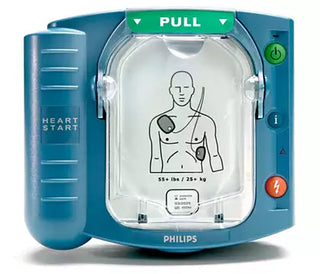
The Philips HeartStart FRx (now Heartstream FRx) is the unit we recommend most often for non-medical facilities. The specifics:
- Three-step operation — pull the handle, place the pads, push the shock button when prompted
- Quick Shock feature typically delivers a shock within 8 seconds after CPR²
- SMART Pads II are pre-connected and work for adults and children (with an optional Infant/Child Key for patients under 55 lb or 0–8 years old, the device automatically adjusts therapy)
- Rugged construction — withstands up to 1,100 lb of compression and drops from 4 feet
- Up to four years between battery replacements with daily, weekly, and monthly automatic self-tests
- Designed for the harshest environments — dusty, wet, high or low temperatures
- Training mode — eight realistic SCA scenarios run on the same unit, switching modes automatically when training pads are installed

Heartstream FRx vs. other AEDs at a glance
Most non-medical-facility AED buyers evaluate the same criteria: ease of use, pediatric capability, battery life, durability, maintenance burden, and warranty terms. The FRx separates itself on three of those: a single pad system that handles both adults and children (no second pad set to stock), an IP55-rated ruggedized build, and the longest practical battery interval in its class. For facilities choosing between the FRx and a competing unit, we'll walk through the side-by-side honestly — there are cases where another device fits better. But for the standard public-facility deployment, this is what we recommend.
The FRx isn't the only AED on the market, and we'll always be honest about whether a different unit makes more sense for your facility. But for the vast majority of non-medical-facility deployments — schools, offices, gyms, manufacturing — the FRx is what we put in front of buyers. See the full FRx supplies and accessories available from Heart Medical →
Accessories that matter as much as the device

A common mistake in AED buying is treating the device as the whole purchase. The accessories around the AED are what make the difference between "we have an AED" and "we can use it in time."
- Wall cabinet with alarm. A cabinet that beeps when opened tells your facility that an emergency is in progress and triggers a response. Premium cabinets connect to internal security systems to mobilize a coordinated response.
- Visible signage. AED awareness placards, wall signs (T-mount, V-mount, or corner mount), and hallway posters direct people to the device. In an emergency, every second searching is a second not saving.
- Fast Response Kit. A small zippered pouch with paramedic scissors, gloves, a pocket breathing mask, a chest razor, and a towel. Stored with the AED, it's the difference between hesitation and action.
- Spare battery and spare pads. Stored with the device, not in a closet across the building. If you train multiple staff, you'll cycle pads faster than the four-year battery cycle suggests.
- Training pads and a trainer unit (or a contracted CPR/AED training program). The American Heart Association recommends practicing AED use at least annually. The device only saves lives if someone confidently picks it up.
A complete AED deployment costs more than just the device. Plan for the accessories, signage, training, and maintenance in the same procurement cycle. See our defibrillator supplies collection for pads, batteries, and cabinets.
How Heart Medical supports AED buyers
We've been a trusted equipment partner to facilities and clinics for years. Our role on the AED side isn't to push a single device — it's to help buyers understand what fits their facility, what the maintenance burden actually looks like, and what the right accessory set is for their specific deployment.
A few specific ways we help:
- Single-site and multi-site AED procurement. Whether you need one unit for a small office or 30 for a school district, we coordinate the right configuration and volume pricing.
- AED placement consultation. Where to mount the cabinet, how many units a facility actually needs based on size and layout, what signage is required by your jurisdiction.
- Pad and battery replacement scheduling. AEDs sit on walls. Their parts expire on a clock that nobody at your facility is tracking. We can build a calendar into your procurement so replacements arrive before expiration, not after.
- Brand transition guidance. If you have existing Philips HeartStart units and new Heartstream-branded units arriving, we can help you understand what stays the same (everything operationally) and what changes (the brand on the box).
Geographic note: Heart Medical sells AEDs to medical facilities (hospitals, clinics, doctors' offices) in 16 western states — Alaska, Washington, Oregon, California, Montana, Nevada, Arizona, New Mexico, Hawaii, Utah, Idaho, Colorado, Nebraska, South Dakota, North Dakota, and Wyoming. Anywhere else in the country, we sell AEDs to non-medical facilities — offices, schools, gyms, churches, hotels, manufacturing, government, and other public-serving sites. If you're not sure whether we can support your specific facility, reply or call us and we'll confirm.

If you're considering AED deployment for your facility, reply to this article or contact us directly at +1 (833) 409-4600. We'll walk through what fits.
Frequently Asked Questions (FAQs)
What is an AED, and how does it work?
An automated external defibrillator (AED) is a portable, battery-powered medical device that detects life-threatening cardiac arrhythmias and delivers an electrical shock to restore a normal heart rhythm. Modern AEDs guide lay rescuers through the process with voice and visual prompts, analyze the patient's heart rhythm automatically, and only allow a shock if one is needed.
Do non-medical facilities need an AED?
Yes. Sudden cardiac arrest can happen anywhere — workplaces, schools, gyms, hotels, houses of worship, retail spaces, and public buildings. Survival depends on receiving CPR and a defibrillator shock within three to five minutes, which is faster than emergency medical services can typically arrive. An on-site AED dramatically increases the chance of survival.
Is the Philips HeartStart FRx the same as the Heartstream FRx?
Yes. As of November 1, 2025, Philips's Emergency Care business became Heartstream — a standalone company. The HeartStart FRx is the same device under the new brand name. Existing Philips-branded units continue to work, and warranties and service support carry over without interruption.
Do you need training to use an AED?
No formal certification is legally required to use an AED — the device is designed to guide untrained rescuers through the steps with voice prompts. That said, the American Heart Association recommends CPR and AED training for facility staff, especially designated responders. Trained users respond faster and more confidently.
Can an AED be used on a child?
Yes. Many modern AEDs, including the Philips HeartStart FRx (now Heartstream), support both adult and pediatric use. For patients under 55 lb (25 kg) or 0–8 years old, an optional Infant/Child Key adjusts the energy delivered and provides age-appropriate voice guidance. The same set of pads works for both adults and children.
How long does an AED battery last?
A quality AED battery typically lasts up to four years installed, with a five-year shelf life unopened. The device performs daily, weekly, and monthly self-tests to verify battery readiness and circuit functionality. A status indicator visible on the device shows whether the unit is ready for use. See our defibrillator supplies collection for compatible replacement batteries and pads.
Where should an AED be placed in a facility?
The general rule is that an AED should be reachable within three minutes of any point in the facility — a round-trip of 90 seconds. For larger buildings, that may mean multiple units placed in lobbies, gymnasiums, hallways near common areas, or break rooms. Cabinets with audible and visual alarms, clear wall signage, and visibility from main traffic paths all increase the chance the device is used in time.
What does an AED program cost beyond the device itself?
A complete AED deployment includes the device, a wall cabinet (basic or premium with alarm), wall signage and awareness placards, a Fast Response Kit (gloves, scissors, breathing mask), a spare battery, a spare pad set, and a maintenance plan for pad and battery replacement. Training (CPR + AED) for designated staff is also a recurring cost. Plan for the complete package, not just the device line item.
How much does an AED cost for a school?
A complete K-12 school AED deployment — device, cabinet with alarm, signage, Fast Response Kit, spare pads and battery, and initial CPR + AED training for designated staff — typically costs between $2,500 and $5,500 per unit, depending on the size of the campus, the cabinet and signage chosen, and the scope of training. Multi-school districts get volume pricing. Florida HB 1607 requires at least one AED per public and charter school by July 1, 2027. Request a quote for an estimate scoped to your district.
Is an AED required in workplaces?
Requirements vary by state and by industry — some states mandate AEDs in specific facility types (gyms, schools, large workplaces), and OSHA encourages AEDs in workplaces where employees may be exposed to electrical hazards or have other elevated cardiac-event risk. Even where not legally required, many employers install AEDs because survival rates for sudden cardiac arrest fall sharply with every minute of delayed defibrillation.
What is the best AED for a school?
For most public and charter K-12 schools, the Heartstream FRx (formerly the Philips HeartStart FRx) is the AED most commonly selected. It supports both adult and pediatric patients with a single pad set (with the optional Infant/Child Key for patients under 55 lb or ages 0–8), is rated for the harsh handling of a school environment, and is simple enough for designated non-medical staff to operate confidently during the first minutes of an emergency.
How often do AED pads expire?
AED pads typically expire every 2 to 5 years depending on the manufacturer and specific pad model. Heartstream FRx SMART Pads II are usually replaced on a 2-year cycle. Self-tests on the device verify pad connectivity but do not extend pad shelf life. See our defibrillator supplies and replacement pads collection for compatible parts, or set up a replacement schedule with our team to receive new pads before expiration rather than after.
About the contributor
Sabrina Elliott, RCIS, CCT
Account Manager, Heart Medical
Sabrina is a Navy Veteran with 30 years of clinical experience specializing in cardiovascular care. She has dedicated her career to providing expert patient care, combining extensive clinical knowledge with a commitment to improving heart health and patient outcomes.
Sources
- Philips HeartStart FRx AED brochure (June 2021)
- Philips HeartStart FRx defibrillator supplies and accessories (September 2025)
- Heartstream brand transition letter (October 2025), Philips Emergency Care
- Florida House Bill 1607 (AED requirement for public and charter schools, effective July 1, 2027)
- Mehra R. Global public health problems of sudden cardiac death. Journal of Electrocardiology. 2007;40(6 Suppl):S118–122.
- Nichol G, Sayre MR, Guerra F, Poole J. Defibrillation for Ventricular Fibrillation: A Shocking Update. Journal of the American College of Cardiology. 2017:70(12):1496–1509.
¹Heart Medical is an authorized distributor of Philips medical equipment and also provides support for other leading brands, including GE HealthCare, Siemens Healthineers, and Mindray. For AED procurement, placement consultation, or maintenance planning, contact us at +1 (833) 409-4600 or info@heartmedical.com.
Reviewed by Heart Medical Clinical Applications Team
Clinical and technical specialists ensuring accuracy and relevance across all Heart Medical content.
Related Products