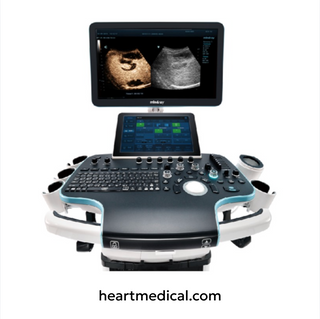
The Mindray Resona 7 is built for clinics that need precise imaging on every exam.
Its ZST+ platform uses zone acquisition and full channel-data processing to produce clearer images than conventional beamforming systems.
This matters in cardiac, vascular, OB/GYN, MSK, and general imaging, where small structures and subtle flow patterns decide diagnoses.
The system runs advanced tools like Dynamic Pixel Focusing, Sound Speed Compensation, HD Scope, and V Flow, giving clinicians deeper detail in challenging cases.
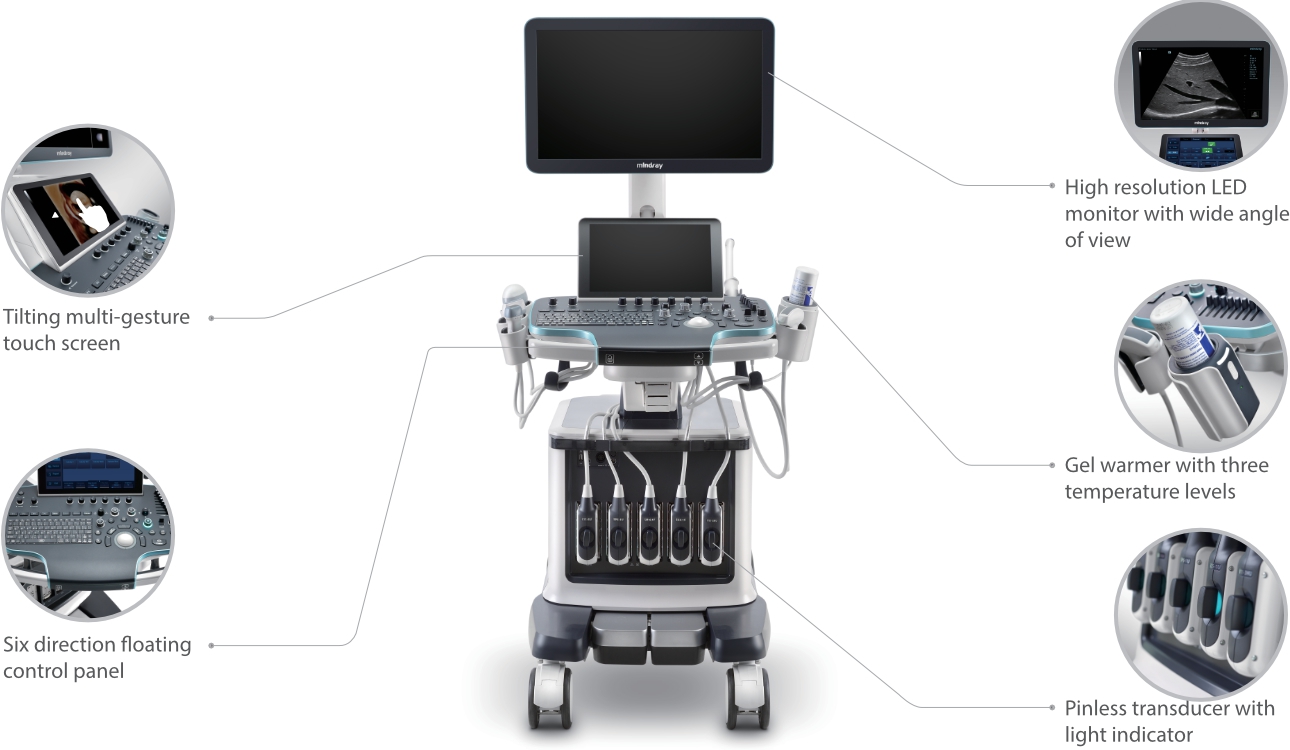
Its interface is fast. The 21.5” HD monitor, multi-gesture control panel, and optimized presets cut scanning time and lower repeat-scan rates.
Clinics with high patient volume benefit because the Resona 7 keeps image quality stable across different operators, reducing dependence on sonographer skill.
This guide covers the system’s core technology, real clinical use, specifications, comparisons, and purchase considerations, so your team can decide if the Resona 7 fits your workflow and upgrade plans.
Choosing the Resona 7 Ultrasound
The Mindray Resona 7 serves clinics that depend on consistent, high-resolution imaging across many patient types.It fits cardiology departments that need sharper vessel borders, stronger Doppler sensitivity, and reliable flow-tracking for complex studies.
Vascular teams benefit from V Flow, which records velocity and direction with clear vector mapping, useful when dealing with stenosis, turbulence, or difficult angles.
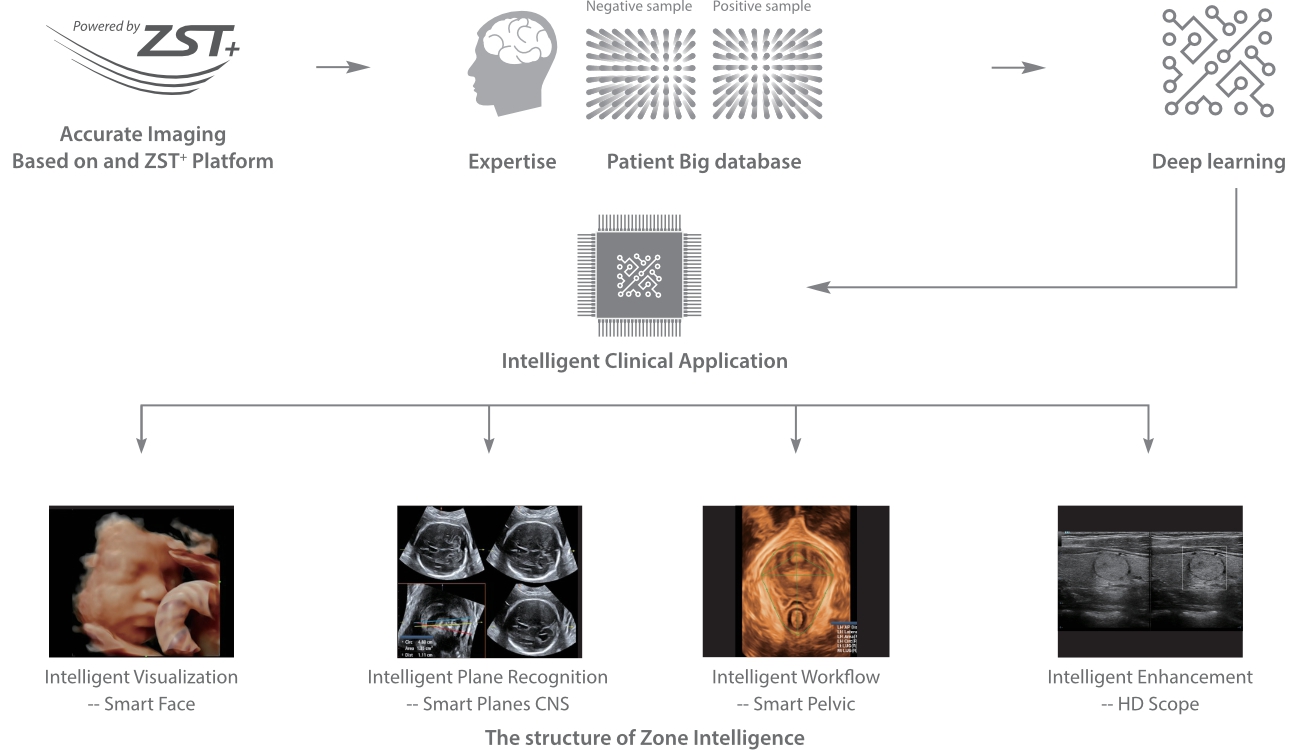
OB/GYN specialists use the system for fetal brain, spine, and cardiac assessments. Smart
Planes, Smart NT, and automated biometric tools reduce scan time and raise measurement accuracy.
MSK centers get a clean visualization of tendons, ligaments, nerves, and subtle soft-tissue changes, even in patients with high BMI.
General imaging and shared-service hospitals choose the Resona 7 because its ZST+ engine stabilizes quality across different operators, making outcomes less dependent on experience.
Teaching institutions gain value because channel-data storage allows retrospective optimization, ideal for training and reviewing difficult cases.
If your facility needs one ultrasound that handles cardiac, vascular, OB/GYN, MSK, abdomen, and small-parts work without switching platforms, the Resona 7 matches that requirement.
Features of Mindray Resona 7 Ultrasound
The Resona 7 runs on ZST+, a channel-data platform that replaces traditional beamforming.
This architecture gives the system more raw acoustic information to work with, which improves clarity in difficult cases.
Below are the technologies that define its performance:
ZST+ Platform (ZONE Sonography Technology Plus)
- Collects full channel data instead of line-by-line echoes.
- Creates images with stronger contrast and smoother tissue boundaries.
- Reduces noise in deep tissue while keeping surface detail sharp.
Dynamic Pixel Focusing
- Calculates focus at every pixel across the entire field of view.
- Removes the need for manual focal-zone adjustments.
- Ensures uniform resolution from near field to far field.
Advanced Acoustic Acquisition
- Acquires large acoustic zones instead of individual scan lines.
- Captures 10× more information per transmit event.
- Improves frame rates during complex exams.
Sound Speed Compensation (SSC)
- Analyzes stored channel data to estimate true tissue sound speeds.
- Corrects speed mismatches caused by fat, muscle, or cystic structures.
- Produces more accurate anatomy shapes in variable body types.
HD Scope
- Enhances fine structures within a selected region of interest.
- Reveals subtle margins, microstructures, and low-contrast lesions.
- Useful for thyroid, breast, MSK, and small-parts imaging.
Coherent Spatial Synthesis
- Combines multiple channel-data reconstructions into a single frame.
- Strengthens signal coherence and edge definition.
- Reduces speckle without smearing texture.
Total Recall Imaging
- Stores raw channel data for later review.
- Allows retrospective changes to gain, TGC, color settings, Doppler, and more.
- Ideal for training, second opinions, and QA workflows.
V Flow (Vector Flow Imaging)
- Displays blood-flow direction and velocity using color vector arrows.
- Provides angle-independent flow analysis.
- Helps visualize turbulence, bifurcations, and complex hemodynamics.
Clinical Applications That Benefit Most From the Resona 7
This section explains how different departments use the machine in real scenarios:
- Cardiology
- Vascular
- OB/GYN & Fetal Imaging
- MSK
- General Imaging / Shared Service
Mindray Resona 7 Compares to Competitors
| Feature / Criteria | Mindray Resona 7 | GE LOGIQ E10 | Philips EPIQ 7 |
|---|---|---|---|
| Premium shared-service platform (radiology, vascular, OB/GYN, cardiac) | ✓ | ✓ | ✓ |
| Core imaging engine | ZST+ channel-data platform | cSound architecture | nSIGHT architecture |
| Advanced vector / flow visualization (e.g., V Flow, semi-quantitative tools) | ✓ – V Flow vector flow imaging | ✓ – semi-quantitative flow tools | ✕ – standard Doppler; no native vector-flow |
| Channel-data “raw” recall for retrospective optimization | ✓ – Total Recall Imaging | ✕ – conventional workflow | ✕ – conventional workflow |
| AI / automation tools (Smart / Anatomical Intelligence style workflows) | ✓ – Smart Planes, Smart OB/NT, Smart FLC | ✓ – AI-based productivity tools | ✓ – Anatomical Intelligence, AI Breast, etc. |
| Fetal CNS, OB/GYN 3D/4D focus | ✓ – Smart Planes CNS, 3D/4D | ✓ – strong but more general imaging focused | ✓ – TrueVue, OB/GYN 3D/4D |
| Elastography options | ✓ – strain / shear-wave options (config dependent) | ✓ – 2D shear-wave elastography | ✓ – elastography packages (config dependent) |
| Large HD display and touch control | ✓ – 21.5" HD + multi-gesture touch | ✓ – HD display + floating keyboard | ✓ – 21.5" HD + 12" touchscreen |
| Ergonomic floating control panel | ✓ – 6-way floating panel | ✓ | ✓ |
| Typical used price range (USD) | ≈ $14,000 – $17,000 (marketplace listings) | ≈ $64,000 – $68,000 (used, config-dependent) | ≈ $47,500+ (used with 2 probes; seller example) |
| Typical new / premium bracket (USD) | ≈ $50,000 – $150,000+ (region and options) | ≈ $50,000 – $150,000+ (region and options) | ≈ $50,000 – $150,000+ (region and options) |
| Best fit summary | High-end imaging with strong price-to-performance; excellent for mixed radiology + OB/GYN + vascular | Flagship radiology / general imaging platform with strong AI and elastography, higher capital cost | Cardiovascular and women’s health powerhouse with advanced 3D/4D rendering, mid–high capital cost |
Conclusion
The Mindray Resona 7 gives clinics a reliable way to reach higher diagnostic accuracy with stable, repeatable image quality. Its ZST+ platform, automation tools, and broad clinical range make it a strong choice for facilities that want premium performance without the premium limitations of older systems. If your team needs one system that handles cardiology, vascular, OB/GYN, MSK, and general imaging with equal confidence, the Resona 7 fits that requirement.
Get the Mindray Resona 7 From Heart Medical
Heart Medical supplies ultrasound systems and replacement parts nationwide.
We provide Resona 7 units, compatible probes, transducers, and service support for clinics of all sizes.
Our team helps you choose the right configuration, arrange delivery, and secure long-term maintenance for your system.
If your facility is planning an upgrade or expanding into new specialties, reach out for a customized quote and availability details
Buy Mindray Resona 7
Download Mindray Resona 7 Brochure
1. What makes the Resona 7 different from conventional beamforming systems?
The Resona 7 uses ZST+ channel-data acquisition, which captures full acoustic data instead of single-line echoes. This allows Dynamic Pixel Focusing, uniform resolution across depth, and retrospective optimization through Total Recall Imaging.
2. How does the Resona 7 handle difficult patients, especially high-BMI cases?
ZST+ improves penetration by processing larger acoustic zones and recalculating focus at every pixel. Sound Speed Compensation adjusts imaging based on tissue variation, producing more accurate structures in deep scans.
3. Can the Resona 7 manage both cardiac and OB/GYN workflows?
Yes. The system supports full cardiac imaging, including CW/PW Doppler and tissue velocity.
For OB/GYN, Smart Planes and Smart NT automate key fetal CNS and biometric measurements, reducing operator variability.
4. Does the Resona 7 support advanced flow visualization?
Yes. V Flow delivers angle-independent vector flow imaging with up to 400 fps.
It displays velocity and direction with color arrows, making it valuable for carotid, peripheral, and complex vascular cases.
5. What probes are commonly used with the Resona 7?
It supports a wide portfolio:
- Phased array for cardiac
- Linear for vascular, MSK, thyroid, breast
- Convex for OB/GYN and abdominal
- Endocavitary for transvaginal exams
-
3D/4D volumetric probes for fetal imaging
These vary by configuration and region.
6. What is Total Recall Imaging and why is it useful?
Total Recall stores complete raw channel data. Clinicians can re-adjust gain, TGC, color, and Doppler parameters after the exam ideal for QA, training, or second opinions.
7. How fast is the workflow compared to older systems?
The multi-gesture touch interface, preset-driven workflows, Smart OB/NT automation, and pixel-level focusing reduce scan time. Clinics report fewer repeat scans because the system maintains consistent image quality across operators.
8. Is the Resona 7 compatible with PACS and hospital IT systems?
Yes. It supports DICOM, structured reporting, cine streaming, and networked storage.
It can integrate into PACS, EMR, and RIS, depending on your IT setup.
9. What is the typical lifespan of a Resona 7 with proper maintenance?
Premium ultrasound carts generally last 7–12 years, depending on usage, environment, and service quality.
Availability of probes, parts, and software updates helps extend its operational life.
10. Do replacement probes and parts remain available?
Yes. Resona-series components, including transducers, control panels, and internal modules, remain widely available through authorized suppliers.
Heart Medical provides nationwide access to compatible probes and replacement parts.
Reviewed by Heart Medical Clinical Applications Team
Clinical and technical specialists ensuring accuracy and relevance across all Heart Medical content.