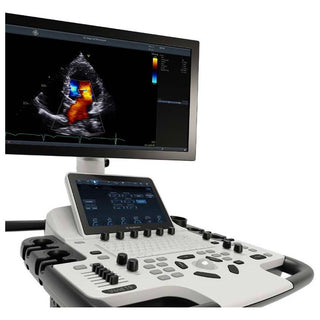
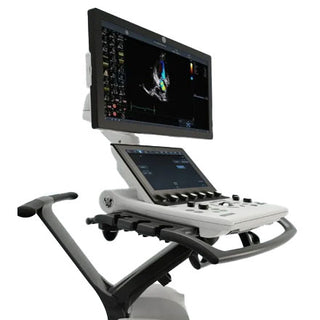
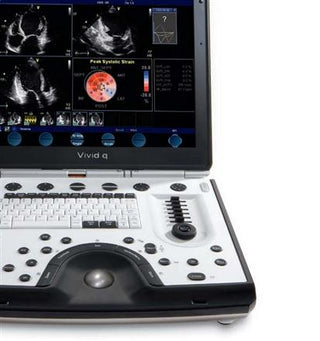
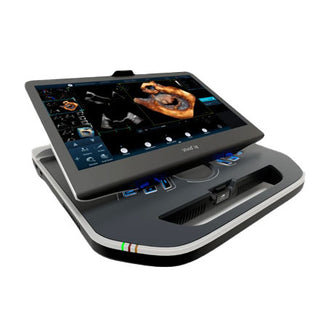
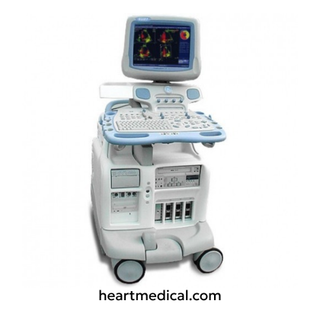
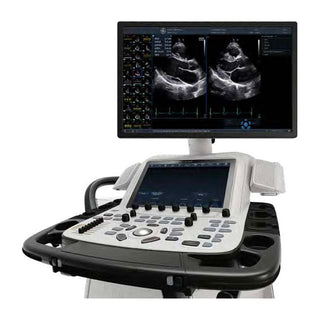
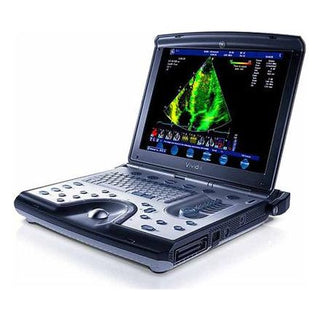
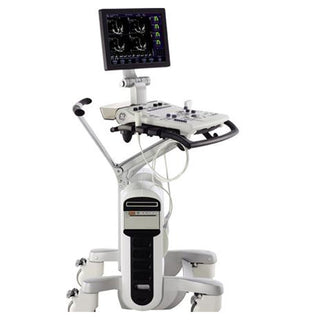
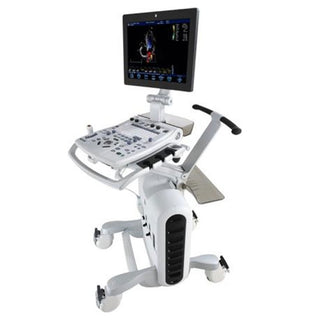
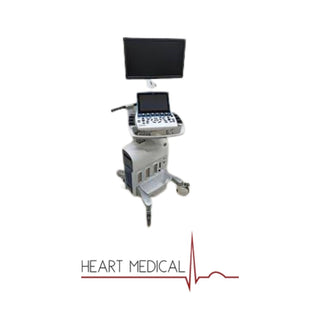
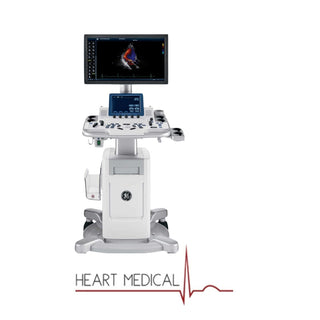
The GE Vivid T9 is a high-end, reliable ultrasound machine designed for cardiac imaging and other cardiac-related medical specialties. Its advanced features, including exceptional image quality, make it an appropriate choice for private clinics, diagnostic centers, and hospital departments.
However, many nuanced considerations must be taken into account before buying the GE Vivid T9. To ensure that it meets your clinical needs, we’ll discuss its advanced features, technical specifications, and some limitations.
When to Choose the GE Vivid T9 Ultrasound Machine

If You Need Advanced Cardiac Imaging
The Vivid T9 is equipped with GE’s renowned cardiac imaging capabilities, including features like Strain Imaging and AutoEF for precise cardiac evaluations. It’s ideal for cardiology-focused practices and hospitals requiring superior diagnostic accuracy for cardiac care.
If Portability and Ergonomics Are a Priority
With its lightweight, compact design and height-adjustable cart, the Vivid T9 is perfect for facilities needing a mobile solution. Its ergonomic design reduces operator strain during extended use.
If You Need Shared Services Flexibility
The Vivid T9 supports a range of imaging applications beyond cardiology, including vascular, abdominal, and OB/GYN. If your facility handles diverse patient cases, this machine offers excellent versatility.
If You Value Workflow Integration
The system integrates seamlessly with PACS, HIS, and EHR platforms, making it an excellent choice for facilities prioritizing streamlined workflows and easy data sharing.
If Budget Is a Concern Without Compromising Quality
The GE Vivid T9 delivers premium features at a competitive price point. It's a cost-effective solution for healthcare providers seeking high-end capabilities without exceeding their budget.
When to Consider Other Options

If You Need High-Volume Imaging for Non-Cardiac Specialties
While the Vivid T9 offers shared service functionality, facilities focusing exclusively on high-volume imaging in non-cardiac specialties may benefit from dedicated machines tailored to those applications.
If You Require Cutting-Edge 4D Imaging
The Vivid T9 provides excellent 2D and some advanced 3D imaging capabilities, but facilities that rely heavily on 4D imaging for OB/GYN or cardiac cases may prefer higher-end models like the GE Voluson series.
If Your Facility Has Space Constraints for Larger Systems
While the Vivid T9 is compact, handheld or tablet-based ultrasound devices may be more suitable for extremely tight spaces or point-of-care diagnostics.
If Your Budget Allows for Premium Models
Facilities with a higher budget and the need for cutting-edge technology might consider the GE Vivid E90 or E95 for even more advanced imaging and features.
If You Need Extremely Specialized Features
If your practice requires features such as Elastography for liver imaging or highly advanced vascular tools, other GE models or competing brands with specialized capabilities might be a better fit.
Features Explanation for Vivid T9

Beyond basic diagnostic capabilities, the GE Vivid T9 has advanced imaging technologies to meet your specific clinical requirements.
Speckle Tracking Echocardiography (STE)
High-frame-rate imaging algorithms in STE enable GE Vivid T9 to analyze myocardial strains and torsion facilitating early detection of myocardial abnormalities. It also helps detect subclinical cardiac dysfunction in patients undergoing chemotherapy or hypertrophic cardiomyopathy.
By visualizing strain patterns, STE aids in risk stratification and treatment planning especially when the ejection factor appears normal but myocardial efficiency is impaired.
Clinical Fit
Vivid T9 is best for clinical settings specialized in cardiology practices focusing on precision diagnostics in heart failure and pre-clinical conditions. It may not be ideal for general cardiology practices where conventional echocardiography is sufficient.
Strain Imaging
GE Vivid T9's advanced feature equips Doppler and 2D-based algorithms ideal for quantifying myocardial deformation. Beyond basic strain and strain rate, it offers global longitudinal strain (GLS) to assess left ventricular dysfunction.
Assessing left ventricular dysfunction might be helpful in diseases like amyloidosis and diabetic cardiomyopathy. Moreover, GLS has prognostic significance in medical conditions like mitral regurgitation and aortic stenosis, offering qualifying clinical data.
Shear Wave Elastography (SWE)
Shear wave elastography is another advanced feature of GE Vivid T9 Ultrasound machine. It enables you to characterize tissues by quantifying stiffness through propagating shear waves.
Unlike traditional elastography, SWE helps in measuring absolute tissue elasticity to evaluate early fibrosis in organs like the liver or kidneys. This feature also supports vascular applications like arterial stiffness assessment which is an emerging marker in cardiovascular risk profiling.
Hepatology
Vivid T9 is an ideal fit for hepatology or nephrology specialists facilitating comprehensive cardiovascular risk evaluations. Not appropriate for standard cardiovascular-focused settings unless supported by a multidisciplinary approach.
Based on these advanced imaging modalities, GE Vivid T9 is best for clinical settings specializing in expanded diagnostic capabilities. However, for routine imaging these features might surpass operational needs, leading to underutilization.
Technical Specifications
Beyond advanced features, there are some technical specifications to consider before buying the GE Vivid T9.
Transducer and Frequency Bandwidth
The Vivid T9 has an entire transducer collection ranging from 4 to 12 MHz high-frequency linear probes to 2 to 8 MHz low-frequency phased-array transducers. High-frequency linear probes are designed for examining superficial structures, however, low-frequency phased-array transducers are ideal for deep tissue penetration.
This makes Vivid T9 best for cardiac and abdominal imaging, ensuring accurate visualization of deeper anatomical structures. Each transducer has advanced piezoelectric material technology to enhance sensitivity and resolution. Knowledge of frequency bandwidth ensures optimal penetration without compromising resolution, especially helpful in obese patients.
Image Optimization Algorithms
GE Vivid T9 ultrasound system has remarkable image enhancement tools including Speckle Reduction Imaging (SRI) and AutoEF (automatic ejection fraction assessment). These tools work in conjunction with multi-dimensional adaptive filtering to reduce artifacts and enhance tissue contrast.
Being familiar with machine learning-assisted optimization, like Scan Assist Pro, ensures consistency across operators and improves efficiency in high-volume settings. Also, Vivid T9 has auto-optimization features designed to handle high-stress environments including emergency departments or intraoperative settings.
Enhanced Doppler and Hemodynamic Analytics
Beyond standard pulsed-wave and continuous-wave Doppler, the Vivid T9 offers advanced tissue Doppler imaging (TDI) with strain rate and deformation mapping. These features provide invaluable insights into myocardial mechanics, particularly in the early detection of diastolic dysfunction and regional wall motion abnormalities.
However, achieving reliable hemodynamic assessments requires an understanding of angle dependence, aliasing thresholds, and signal-to-noise ratios. This helps in challenging conditions such as arrhythmias or prosthetic valves. This capability is ideal for clinical centers focused on advanced cardiac care but may require additional training for full utilization.
Custom Workflow Integration and Data Management
The system supports integration with hospital information systems (HIS) and picture archiving and communication systems (PACS) via DICOM standards. The Vivid T9 offers configurable workflow presets and automated measurement packages designed for specific subspecialties, such as pediatric cardiology or vascular imaging.
You must assess whether these workflows and customization options align with your clinical protocols and reduce overall scanning time with improved output.
System Scalability
The GE Vivid T9 is designed with modular components that allow for future upgrades, including advanced imaging capabilities or newer transducers. Moreover, its software updates can be seamlessly integrated, ensuring the system stays current with the latest technologies and regulatory requirements.
You can benefit from ongoing software enhancements, such as improved imaging algorithms or new imaging modes, by accessing GE’s support and update services.
AI Compatibility
The GE Vivid T9 is compatible with AI-diagnostic tools including automated measurements for cardiac function and advanced image processing algorithms. GE’s EchoPAC software integrated into the Vivid T9 supports AI-based tools that assist in strain imaging and automated ejection fraction calculations.
Also, it is likely to incorporate additional AI features through software updates to stay aligned with the industry's technological advancements.
Limitations
While the GE Vivid T9 is a highly capable cardiovascular ultrasound system, it does have certain limitations that may impact its suitability for specific clinical applications.
Limited 3D/4D Imaging Capability
Detailed assessments in complex cardiac surgeries or fetal cardiac evaluations in obstetric practices may require high-quality 3D/4D imaging. However, the Vivid T9 performs standard 2D imaging and doesn’t offer the same depth of volumetric cardiac imaging.
Less Specialized for Non-Cardiac Imaging
While it performs well in cardiovascular applications, the Vivid T9 is less versatile for general imaging needs outside of cardiology. It may not offer the same level of diagnostic precision for non-cardiac applications, such as musculoskeletal or abdominal imaging.
Training and Experience Required for Full Utilization
Many of the advanced imaging features on the Vivid T9 require a significant level of operator expertise to use effectively. For institutes with less experienced sonographers, maximizing the system's capabilities may be challenging, requiring additional training to achieve optimal results.
Conclusion
The GE Vivid T9 ultrasound machine excels in the versatility required in cardiology clinics, vascular labs, and multi-disciplinary hospitals. However, for practices focusing on basic imaging or with budget constraints, alternative options offering only essential features could be more appropriate.
Order GE Vivid T9 Ultrasound Machine
Heart Medical offers the GE Vivid T9 Ultrasound Machine with new, demo, and refurbished options, all backed by the original manufacturer’s warranty. Designed for exceptional cardiovascular imaging, the Vivid T9 delivers reliable performance and advanced features. With nationwide delivery, we make it easy to equip your facility with this trusted diagnostic solution. Contact team
Frequently Asked Questions
1. What is the GE Vivid T9 ultrasound machine best suited for?
The GE Vivid T9 is ideal for cardiovascular imaging and shared services. It excels in applications like cardiac, vascular, abdominal, and OB/GYN imaging, offering versatility and advanced diagnostic capabilities.
2. How does the GE Vivid T9 improve workflow in healthcare facilities?
The Vivid T9 integrates seamlessly with systems like PACS, HIS, and EHR, allowing for efficient data sharing and streamlined workflows. Its user-friendly interface and automated features reduce operator workload and improve productivity.
3. Is the GE Vivid T9 portable?
Yes, the GE Vivid T9 is designed with mobility in mind. It features a lightweight, compact design with a height-adjustable cart, making it easy to transport across departments.
4. Does the GE Vivid T9 support advanced cardiac imaging?
Yes, the Vivid T9 includes features like Strain Imaging and AutoEF, which enhance diagnostic precision for cardiac care. These tools make it a preferred choice for cardiology-focused practices.
5. What imaging modes does the GE Vivid T9 support?
The GE Vivid T9 supports multiple imaging modes, including 2D, Doppler, 3D, and some advanced 4D imaging capabilities, providing flexibility for various diagnostic needs.
6. Can the GE Vivid T9 handle shared services in healthcare?
Absolutely. The Vivid T9 is built for shared services, supporting applications in vascular, abdominal, OB/GYN, and other imaging specialties, making it a versatile choice for diverse patient cases.
7. How does the GE Vivid T9 ensure ergonomic use?
The Vivid T9 features a height-adjustable cart, tiltable monitor, and a compact design to reduce operator strain during prolonged use. Its ergonomic design prioritizes user comfort and efficiency.
8. What are the data security measures in the GE Vivid T9?
The Vivid T9 includes robust security features such as data encryption and user authentication to protect patient data and ensure compliance with privacy regulations like HIPAA.
9. When should I consider an alternative to the GE Vivid T9?
Consider alternatives if your facility requires highly specialized features (e.g., Elastography), cutting-edge 4D imaging, or if you have a larger budget for premium models like the GE Vivid E90 or E95.
10. Is the GE Vivid T9 a cost-effective solution?
Yes, the GE Vivid T9 offers advanced imaging features and versatility at a competitive price, making it a cost-effective option for healthcare facilities seeking high-quality diagnostics within budget.
11. What maintenance is required for the GE Vivid T9?
Routine maintenance, including software updates, regular cleaning, and calibration checks, is necessary to ensure optimal performance and longevity of the device.
12. Does HeartMedical provide support for the GE Vivid T9?
Yes, HeartMedical offers the GE Vivid T9 along with expert support, ensuring seamless integration, training, and ongoing assistance for healthcare facilities. Contact us to learn more.
Reviewed by Heart Medical Clinical Applications Team
Clinical and technical specialists ensuring accuracy and relevance across all Heart Medical content.
Related Products