By the Heart Medical Team
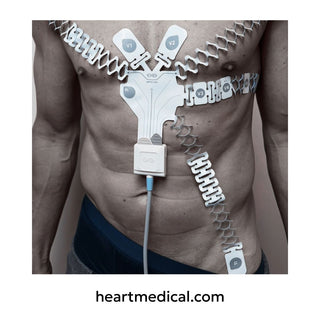
The 12-Lead ECG device known as the EXG™ Wearable ECG Platform, produced by C-Booth Innovations, is a wearable device intended for quick and reliable use in emergency medical services, hospital settings, and in the cath lab. It features a single-cable arrangement, can be worn continuously for up to three days, has a radiolucent build, and is compatible with standard ECG monitors. As a result, a diagnostic 12-Lead ECG recording can be obtained in less than 60 seconds.
The EXG™ platform is now available via Heart Medical for healthcare buyers in the United States.
This buyer’s guide examines what EXG™ is, the problem that it is intended to solve, the four lead configurations that are available, the clinical evidence for the platform, and how deployment can be carried out in EMS, hospital, and cath lab settings.
Why we're adding EXG™ to our catalog
Heart Medical's cardiac monitoring catalog has traditionally focused on the Philips PageWriter cardiograph line, Holter monitoring, and stress-testing systems. Those products cover important parts of cardiac care, but there was still a gap when a 12-lead ECG needs to happen quickly, at the bedside, or in the back of an ambulance, especially when electrode placement is difficult.
The EXG™ Wearable ECG Platform from C-Booth Innovations is designed specifically for that situation.
Developed by two emergency room physicians, EXG™ was built around the practical challenges of acute and field ECG use: consistent electrode placement, motion during vehicle transport, time pressure, the EMS-to-ED handoff, and the electrode-placement errors that have been documented in clinical research.
There is also a local connection worth mentioning. C-Booth Innovations is a medical technology company based in Carlsbad, California, roughly a mile from Heart Medical's Faraday Avenue office. When the opportunity to distribute the platform came up, both the product's engineering and its clinical focus made it a natural addition to our catalog.
The problem with standard 12-Lead ECG deployment
The basic process behind a standard 12-Lead ECG has changed surprisingly little over the years. Ten electrodes have to be placed individually, often by an operator working under significant time pressure. That leaves plenty of room for variation.
Clinical research has documented some of the challenges associated with that process:
- 94.2% electrode misapplication rate in current 12-Lead ECG practice (Rouan et al., Am J Cardiol 1989; 64(18):1087–1092)
- Just 2 cm of electrode misplacement can obscure critical ST-segment changes and hide a heart attack (Bond et al. 2012)
- 29% of suspected STEMI patients do not receive an ECG within 10 minutes of first medical contact (Stopyra et al., Prehosp Emerg Care 2023; 27(4):488–495)
- 72% of unnecessary cath lab activations are linked to ECG misinterpretation, largely driven by upstream misplacement (Degheim et al. 2019)
- 2% mortality increase per minute of delay in prehospital ECG (Bond et al. 2012)
Taken together, these studies point to a fairly straightforward problem: standard ECG deployment can be slow and inconsistent. Misplaced electrodes can contribute to missed findings, while interpretation issues can also lead to unnecessary cath lab activations. Both have consequences for patients and clinical teams.
EXG™ takes a different approach. Instead of trying to solve the problem with another training program or checklist, the platform changes the way the ECG itself is deployed.
What is the EXG™ platform?

The EXG™ Wearable ECG Platform is a single-cable wearable 12-Lead ECG device that delivers a diagnostic ECG recording in under 60 seconds.
The wearable design is intended to place the electrodes in consistent anatomical positions, reducing the variation that can come with manual placement. Once the skin has been prepared, the device can be worn for up to 3 days of continuous monitoring while tolerating diaphoresis and showering.
The platform is available in four lead configurations:
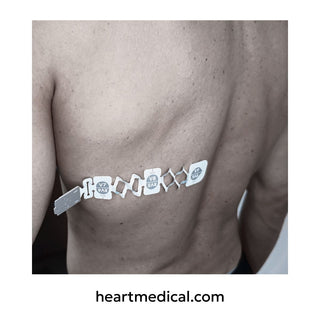
- 12-Lead, the flagship configuration, which can be expanded to 18-Lead for Right-sided and Posterior visualization
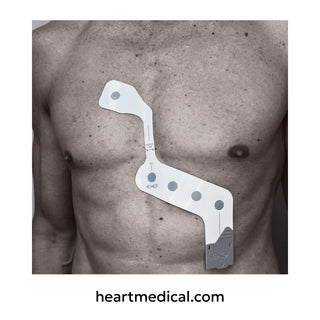
- 5-Lead, designed for continuous rhythm monitoring
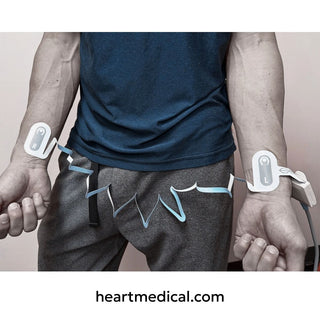
- 4-Electrode (4-Lead), an EMS-focused option for rate and rhythm monitoring on lower-acuity patients
- 3-Lead Reversible, which provides Right-sided and Posterior views on demand
EXG™ also uses a single universal adapter. One cable is designed to work with standard ECG monitors, allowing organizations to integrate the wearable into existing workflows without replacing their entire ECG monitor fleet.
A brief look at the company behind EXG™
C-Booth Innovations was founded in 2017 by two emergency room physicians. The platform's design reflects that clinical background, with the focus starting from practical patient-care needs rather than an engineering concept looking for a clinical application.
Key clinical capabilities
Several features set EXG™ apart from traditional 12-Lead ECG deployment.
1. Single-cable design
A traditional 12-Lead ECG requires ten individual electrode placements, each creating another opportunity for incorrect positioning.
EXG™ uses a single-cable design and one universal adapter, with the wearable designed to position the electrodes consistently.
2. Rapid deployment in under 60 seconds
The single-connection design allows setup in under 60 seconds. In environments where every minute can matter, reducing the time required to obtain an ECG can be particularly important.
3. Up to 3 days of continuous wear
Once the skin has been prepared, the wearable can remain in place for up to 3 days, including during diaphoresis and showering.
For longer hospital stays, that can reduce the number of times electrodes need to be removed and reapplied and help minimize gaps in monitoring.
4. Continuous 12-Lead monitoring across the episode of care
One of the practical advantages of the wearable approach is that the ECG can stay with the patient as they move through different stages of care.
That can include EMS arrival, ED triage, ICU care, cath lab procedures, and recovery, without having to start the electrode-placement process over at every handoff.
The EMS-to-ED transition can use the same universal adapter, eliminating the need for rewiring or repositioning the wearable.
5. Expandable to 18-Lead
For additional STEMI evaluation, the 12-Lead configuration can be expanded to 18-Lead by adding Right-sided and Posterior visualization.
This allows programs to obtain additional views without introducing a completely separate ECG platform.
6. Motion artifact reduction
Improved methods for high-activity environments — vibration and movement during prehospital transport, procedure tables, and active patients.
Universal compatibility means one cable fits any standard ECG monitor, including Philips PageWriter EKGs and Philips Patient Monitors already in use across Heart Medical's customer base — no fleet replacement required.
7. Radiolucent design and CPR compatibility
The wearable is X-ray transparent, allowing cath lab teams to continue ECG monitoring during fluoroscopy and angiography without having to reposition the electrodes for imaging.
The platform is also compatible with Manual and Mechanical CPR, including LUCAS, allowing it to remain in place during resuscitation.
These features become particularly relevant in cath lab and interventional cardiology workflows, where maintaining monitoring throughout a procedure can be important.
The four configurations
Choosing the right EXG™ configuration is one of the first decisions to make when evaluating the platform. Each configuration is designed for a different monitoring need.
EXG™ 12-Lead (flagship)

EXG™ 12-Lead (flagship) provides continuous diagnostic 12-Lead monitoring across the episode of care, with up to 3 days of continuous wear.
It is CPR compatible, including Manual and Mechanical CPR/LUCAS, and its radiolucent design makes it suitable for cath lab applications.
The configuration can also be expanded to 18-Lead by pairing it with the reversible 3-Lead for Right-sided and Posterior visualization.
This is the primary configuration for programs that need diagnostic ECG capabilities, including EMS agencies running STEMI transport protocols, emergency departments conducting chest pain evaluations, and cath labs that need continuous monitoring during procedures.
EXG™ 5-Lead

EXG™ 5-Lead is designed for continuous rhythm monitoring, with an electrode shape intended to support cleaner P-wave and QRS morphology.
With up to 3 days of continuous wear, the platform requires only two applications during an average 5.5-day hospital stay.
It is particularly suited to medical/surgical floors, ICU beds, and telemetry step-down units where ongoing arrhythmia surveillance is the primary need rather than diagnostic ECG acquisition.
EXG™ 4-Electrode (4-Lead)

EXG™ 4-Electrode (4-Lead) is the EMS-oriented configuration for rate and rhythm monitoring on lower-acuity patients.
It offers multiple placement options, including wrist-to-wrist, limb-to-limb, and limb-to-torso configurations, giving EMS teams flexibility based on the patient's position and circumstances.
Like the other configurations, it uses a rapid single-connection setup.
It is intended for assessing lower-acuity patients where full diagnostic information may not be required.
EXG™ 3-Lead (Reversible)

EXG™ 3-Lead (Reversible) provides both Right-sided and Posterior visualization in a single reversible configuration.
Anatomical landmarks are incorporated into the design to support consistent placement across shifts and users.
The configuration is CPR compatible and can be paired with the 12-Lead flagship to provide an 18-Lead diagnostic view for additional STEMI detection and RV MI evaluation.
For many cardiac care programs, the 12-Lead flagship will serve as the primary configuration. The reversible 3-Lead can be added when Right-sided or Posterior views are needed, while the 5-Lead provides an option for continuous rhythm surveillance.
Clinical applications by environment
The EXG™ platform can serve different purposes depending on where it is being used. EMS crews, hospital teams, and cath labs all face different operational challenges, even though they share the need for reliable ECG monitoring.
EMS / prehospital
The prehospital environment leaves very little room for wasted time.
Clinical literature has linked delays in obtaining a prehospital ECG with increased mortality, while obtaining a consistent 12-Lead ECG inside a moving ambulance can be challenging even for experienced paramedics.
There are several factors at play: limited space, vehicle movement, patient movement, time pressure, and situations where a single provider may be handling multiple responsibilities.
EXG™ is designed to simplify that process. The single connection enables setup in under 60 seconds, while motion-artifact reduction is intended to support ECG acquisition in high-activity environments such as vehicle transport.
Universal monitor compatibility is another practical consideration. EMS agencies can use the EXG™ platform with existing ECG monitors rather than replacing an entire fleet of Zoll X Series or Physio-Control LP15 monitors.
For an EMS agency, the EXG™ 12-Lead is typically the starting point for STEMI transport. The EXG™ 4-Electrode (4-Lead) can be used for rate and rhythm monitoring on lower-acuity calls.
Because both configurations use the same universal adapter, agencies can maintain a common connection system across different use cases.
Hospital / acute care
Hospitals face a different version of the same challenge: high patient volumes, frequent handoffs, time pressure, and the potential for electrode-placement errors.
The documented 94.2% electrode misapplication rate cited earlier illustrates why consistency remains an important consideration in ECG acquisition.
EXG™ is designed to address placement variability at the source. The wearable format is intended to position electrodes consistently across the ED, ICU, medical/surgical floors, and cardiology settings, regardless of which staff member applies it.
The up-to-3-day wear time also means fewer electrode reapplications. For patients who require monitoring over several days, that can help reduce interruptions and repeated setup.
Typical hospital applications include:
- Emergency department triage and continuous ED monitoring
- ICU and critical care continuous cardiac monitoring
- Medical/surgical floor monitoring for stroke, post-op, or arrhythmia workup patients using the 5-Lead configuration
- Cardiology consults, pre-stress-echo assessment, and pre-procedure ECG
Cath lab / interventional cardiology
The cath lab presents a different challenge.
During procedures, teams need both continuous ECG monitoring and clear imaging. Standard ECG electrodes can appear on fluoroscopy, creating a choice between leaving them in place and potentially interfering with imaging or removing them and interrupting continuous ECG monitoring.
EXG™ is designed to avoid that trade-off through its radiolucent construction.
The wearable can remain in place while the patient moves through assessment, intervention, and recovery, allowing continuous 12-Lead ECG monitoring without having to reposition the electrodes for imaging.
The platform is also compatible with Manual and Mechanical CPR, including LUCAS, so the wearable can remain in place during resuscitation when necessary.
Potential cath lab applications include:
- Diagnostic cath and coronary angiography with continuous ECG monitoring throughout the workup
- PCI procedures requiring continuous 12-Lead monitoring during intervention
- Structural heart procedures, including TAVR and MitraClip planning and delivery
- Peri-procedural monitoring in recovery areas before patients return to the floor
The cited 72% rate of unnecessary cath lab activations linked to ECG misinterpretation also highlights the importance of reliable ECG acquisition upstream. At the same time, the radiolucent design offers a more immediate workflow benefit: teams can maintain ECG monitoring without introducing an imaging-related electrode problem.
Radiolucent design: why cath labs are paying attention
One of the more distinctive features of EXG™ is its X-ray-transparent, or radiolucent, design.
In a standard cath lab workflow, ECG electrodes can appear on fluoroscopy. That creates a practical trade-off: leave them in place and potentially interfere with imaging, or remove them and lose continuous ECG monitoring.
With EXG™, the electrodes can remain in place while imaging continues.
That means cath lab teams can maintain continuous 12-Lead ECG monitoring throughout the procedure without having to reposition the wearable for fluoroscopy or angiography.
Combined with CPR compatibility, including Manual and Mechanical CPR/LUCAS, this gives the platform several advantages for interventional cardiology teams evaluating continuous ECG monitoring during procedures.
Clinical evidence
C-Booth Innovations developed EXG™ in response to clinical literature documenting several limitations associated with conventional 12-Lead ECG deployment.
The studies cited throughout this guide include:
- Rouan et al., Am J Cardiol 1989; 64(18):1087–1092 — Electrode misapplication rate in current 12-Lead ECG practice: 94.2%.
- Bond et al. 2012 — Impact of electrode misplacement on ECG interpretation, including the potential for 2 cm of misplacement to obscure critical ST-segment changes. The study is also cited for the reported 2% mortality increase per minute of delay in prehospital ECG.
- Stopyra et al., Prehosp Emerg Care 2023; 27(4):488–495 — Percentage of suspected STEMI patients not receiving ECG within 10 minutes: 29%.
- Degheim et al. 2019 — Percentage of unnecessary cath lab activations linked to ECG misinterpretation: 72%.
- Bosson et al. — Transmission rate during acute MI in prehospital ECG telemetry: 28%.
- Newman et al. 2022 — Annual U.S. missed/delayed MI detection rate: 27.5%. Annual wrongful death exposure estimated at $2.4B.
For programs evaluating the platform, the C-Booth Innovations clinical page provides the full evidence set and internal validation studies.
Certifications and compliance
Certified for professional medical use: FDA-Registered, AHA-Compliant & ISO-13485 Certified.
Manufactured by C-Booth Innovations, founded in 2017 by two emergency room physicians.
For hospital biomedical and clinical engineering teams evaluating the platform for institutional purchase, C-Booth's compliance page provides additional information about its regulatory registrations.
How Heart Medical supports EXG™ buyers
Heart Medical distributes the EXG™ Wearable ECG Platform across the U.S. for EMS agencies, hospitals, and cath labs.
Our support can include:
- EMS agencies: pilot program planning, ambulance fleet deployment, integration with existing ECG monitors, and standing-order consumables
- Hospitals: ED, ICU, and med-surg deployment planning, integration with existing telemetry infrastructure, biomed sign-off support, and applications training coordination
- Cath labs: configuration walkthroughs, continuous-procedure monitoring demonstrations, radiolucent workflow demonstrations, and integration with existing cath lab monitoring systems
A few specific ways we help
Configuration scoping. Different environments have different monitoring needs. We help determine which of the four EXG™ configurations makes sense for your program before putting together a quote.
Volume purchasing. Multi-site health systems, multi-station EMS agencies, and cath lab networks can qualify for volume pricing.
Existing infrastructure integration. Universal monitor compatibility is built into the EXG™ design, but the specific connection with your existing Zoll, Physio-Control, Philips, or GE monitors should be reviewed before deployment.
Consumables planning. EXG™ uses single-use, per-patient electrode sets. Organizations with predictable patient volumes can benefit from setting up standing orders for more consistent inventory and delivery.
Local support. C-Booth Innovations and Heart Medical are both based in Carlsbad, California. That gives customers a relatively direct path for technical questions, escalations, and pilot program discussions.
If your organization is evaluating EXG™ for EMS, hospital, or cath lab use, contact Heart Medical or call +1 (833) 409-4600. Our team responds within one business day.
We have also prepared audience-specific one-page brochures for EMS, hospital, and cath lab applications. Ask your Heart Medical account manager or request them through the contact link above.
Frequently Asked Questions
What is the EXG™ Wearable ECG Platform?
The EXG™ is a wearable 12-Lead ECG device manufactured by C-Booth Innovations for use across EMS, hospital, and cath lab environments.
It uses a single-cable wearable design that enables a diagnostic 12-Lead recording in under 60 seconds. The platform supports up to 3 days of continuous wear, is compatible with Manual and Mechanical CPR/LUCAS, and uses a radiolucent design for continuous monitoring during cath lab procedures.
Who makes the EXG™?
The EXG™ is manufactured by C-Booth Innovations, a medical technology company based in Carlsbad, California. The company was founded in 2017 by two emergency room physicians.
Heart Medical is the U.S. distributor.
Is the EXG™ FDA-registered?
Yes. The EXG™ is FDA-Registered, AHA-Compliant & ISO-13485 Certified for professional medical use.
What lead configurations are available?
There are four configurations:
- 12-Lead: flagship configuration for continuous diagnostic monitoring, expandable to 18-Lead, CPR compatible, and radiolucent
- 5-Lead: continuous rhythm monitoring with up to 3 days of wear
- 4-Electrode (4-Lead): EMS-optimized rate and rhythm monitoring for lower-acuity patients
- 3-Lead Reversible: provides Right-sided and Posterior visualization in a single configuration
How long does deployment take?
The single-connection design enables setup in under 60 seconds.
Does the EXG™ work with our existing ECG monitors?
One cable fits any standard ECG monitor. Universally compatible with the ECG monitors used across EMS (Zoll X Series, Physio-Control LP15) and hospital settings — including Philips PageWriter EKGs and Philips Patient Monitors, which are widely deployed across Heart Medical's customer base. No monitor fleet replacement required. Confirm integration with your specific configuration before purchase.
What does "radiolucent" mean, and why does it matter for cath labs?
Radiolucent means the EXG™ wearable is X-ray transparent and does not appear in the same way as standard electrodes during fluoroscopy or imaging.
For cath lab teams, this means the wearable can remain in place during the procedure without requiring electrode repositioning for imaging. Continuous 12-Lead ECG monitoring can therefore continue throughout the procedure.
How long can the EXG™ be worn?
The EXG™ can be worn for up to 3 days continuously.
Once the skin has been prepared, the wearable is designed to tolerate diaphoresis and showering, reducing the need for repeated electrode application during the episode of care.
How does the EXG™ compare to a standard 10-electrode 12-Lead ECG?
Both provide a 12-Lead diagnostic ECG. The main difference is how the ECG is deployed.
A standard ECG requires ten individual electrode placements. EXG™ uses a single-cable wearable design intended to provide consistent anatomical placement, with setup in under 60 seconds and the ability to remain in place for up to 3 days.
Where should I buy the EXG™?
The EXG™ should be purchased through an authorized distributor to ensure access to the manufacturer's warranty, current firmware, and certified support.
Heart Medical is a U.S. distributor for the EXG™ platform. Contact our team or call +1 (833) 409-4600.
Are the electrodes single-use or reusable?
The EXG™ wearable electrode sets are single-use, per-patient consumables.
About the manufacturer
C-Booth Innovations is a medical technology company based in Carlsbad, California, founded in 2017 by two emergency room physicians.
C-Booth's product page and clinical evidence page provide additional product specifications, clinical validation, and case-study documentation.
About Heart Medical
Heart Medical is a Carlsbad, California distributor of cardiac equipment and supplies, including the EXG™ platform, Philips cardiovascular ultrasound systems, PageWriter EKG systems, ST80i stress-testing systems, and Holter monitors.
Our operating principle, Where Quality Meets Conscience, reflects how we approach equipment recommendations: the goal is to help healthcare organizations find equipment that fits their clinical and operational needs, rather than simply recommending the product with the highest margin.
Sources
- C-Booth Innovations: Official product page — manufacturer specifications and clinical documentation
- C-Booth Innovations: Clinical evidence — clinical evidence and validation studies
- C-Booth Innovations: Compliance — regulatory registrations
Heart Medical distributes the EXG™ Wearable ECG Platform for U.S. EMS agencies, hospitals, and cath labs. For procurement scoping, pilot program planning, or standing-order consumables, contact us at +1 (833) 409-4600 or info@heartmedical.com.
Reviewed by Heart Medical Clinical Applications Team
Clinical and technical specialists ensuring accuracy and relevance across all Heart Medical content.
Related Products